


SOLAR AUTOMATION By Product type:

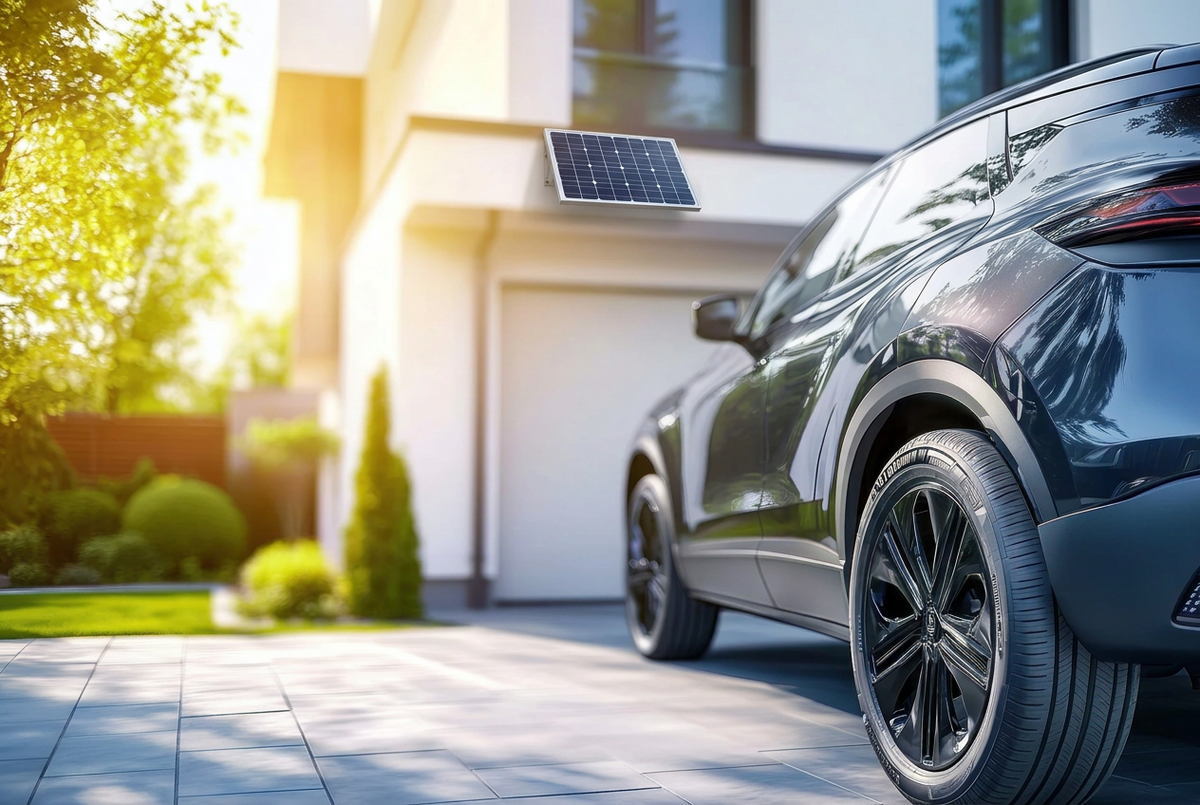

Solar automation for gates , garage doors, and window shutters
SHOP SOLAR OPENERS
Ducati Home offers fully autonomous, solar-powered motorizations 100% made in Italy and designed for long-term reliability and high energy efficiency.
Professional systems engineered to meet the requirements of homeowners and installers alike.
Sun is all you need, and sun is always there.
Ducati’s solar-powered gate & garage door openers turn solar energy into reliability.
Choosing a Ducati solar system means cutting your passive energy costs to zero, drastically reducing your electricity bills, and minimizing your environmental footprint.
SELECT THE OPENER BASED ON YOUR DOOR OR GATE TYPE:


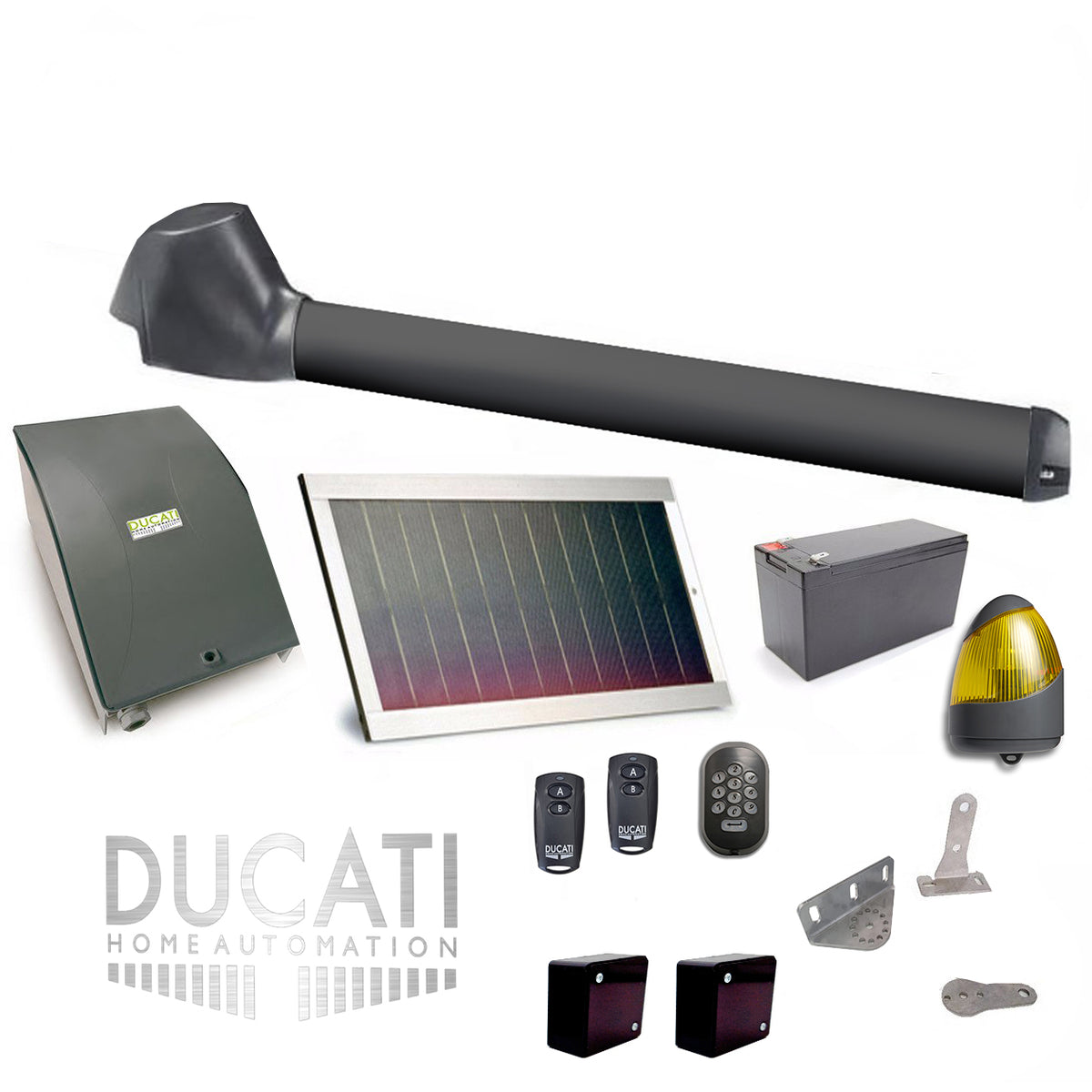
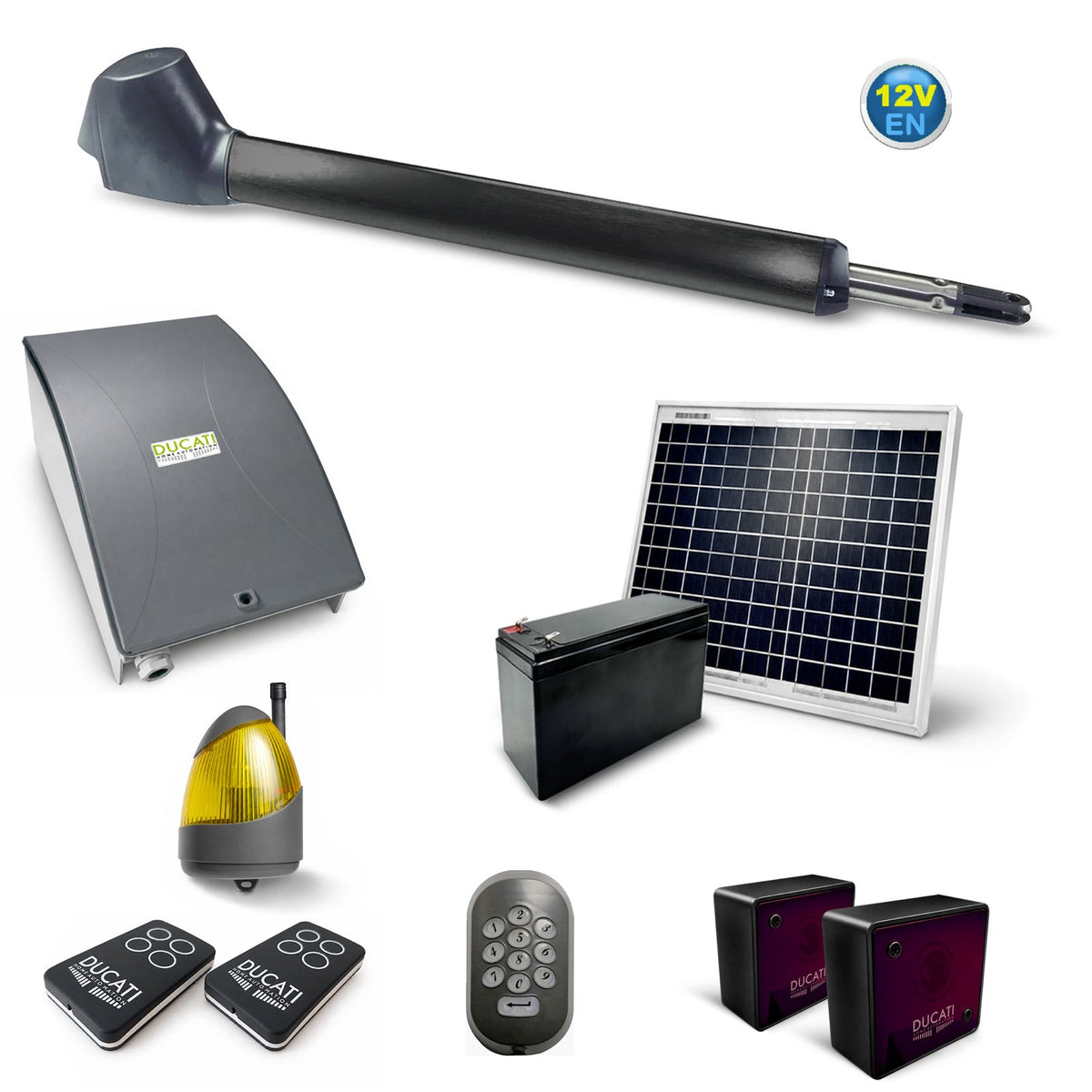


Ducati Solar openers
- The Stand-By Breakthrough: automations draw power constantly because they stay turned on waiting for a remote control command. Ducati has engineered a breakthrough technology that minimizes stand-by power consumption to near-zero milliampere levels.
- Compact Efficiency & Reliability: This revolutionary stand-by reduced consumption ensures exceptionally high autonomy and total system reliability using highly compact, non-bulky solar panels and batteries.
- 50 Daily Cycles Guaranteed: A standard residential ducati solar gate opener guarantees up to 50 daily opening cycles without depleting the battery charge, requiring only 5 to 6 hours of daylight exposure.
- Scalable for High-Traffic Condominiums: For shared properties or intensive commercial use, the system is scalable. The battery capacity and solar panel size can be easily increased to flawlessly match high-frequency workload.
Eco-Friendly Technology & Uncompromised Autonomy
For over 30 years, we have been pioneers in developing low-consumption automation systems powered by 12V and 24V Direct Current (DC).
DUCATI's mission?
To guarantee maximum operating autonomy with the smallest footprint possible.
The secret behind our exceptional efficiency isn't just the power of our motors—it’s how smartly we manage energy.
A typical gate opening cycle only takes between 10 and 30 seconds.
However, automation systems constantly drain energy 7/24h even when sitting idle, just waiting for a remote command.
Thanks to our proprietary energy-saving technology—developed, tested, and continuously refined over the last three decades,
we have successfully reduced standby power consumption to an incredible 0.003 A/h.
This major technological breakthrough allows our systems to run flawlessly on compact, non-invasive solar panels and small batteries, while still delivering outstanding autonomy and long-term reliability.
Choosing a DUCATI solar system means total independence from the power grid, zero electricity bills, and a concrete contribution to preserving our planet's resources—whether for residential homes or isolated rural properties.

Shop DUKAPP line SOLAR openers


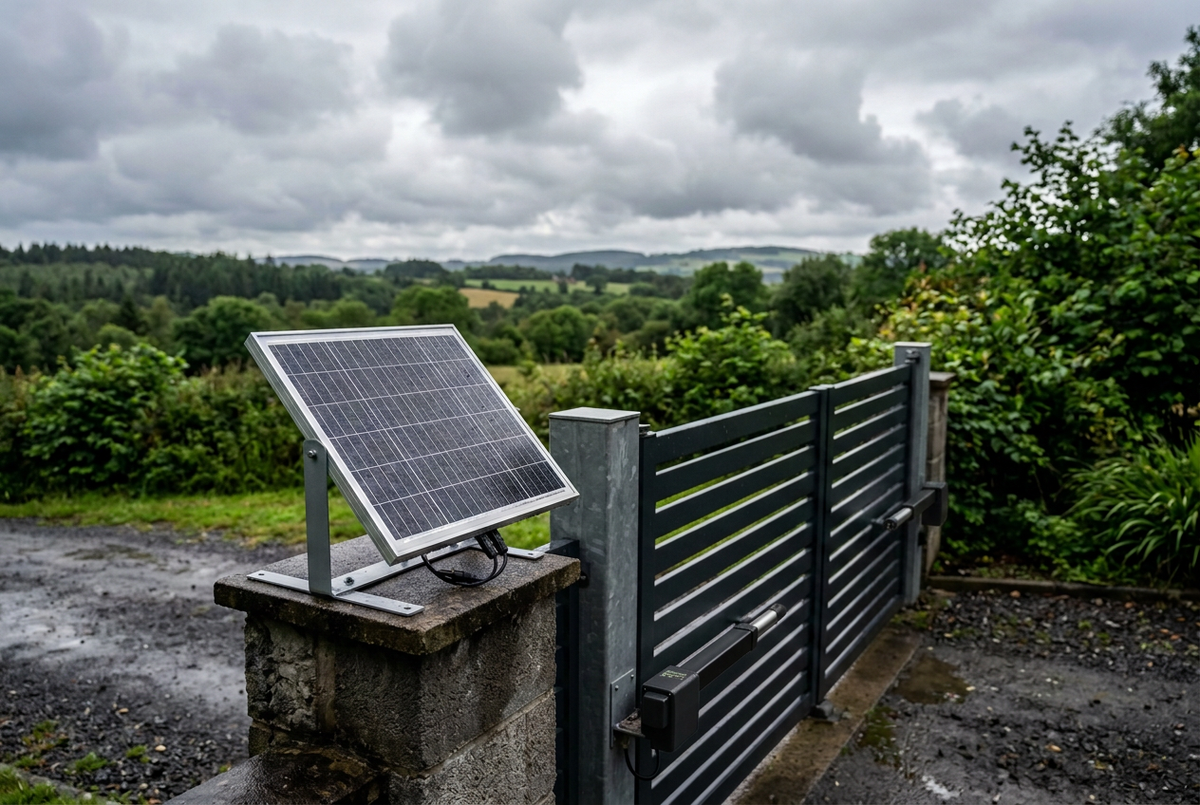
Solar Power for Challenging Environments
- Winter & Heavy Fog Resilience: For regions with harsh winter conditions, extended shade, or thick fog, energy storage can be easily customized. Upgrading to a higher amperage battery dramatically increases your energy reserve, providing many days of total autonomy even during zero-solar recharge periods (such as heavy snow or continuous bad weather).
- Optimized Solar Efficiency: Depending on the specific automation model selected, it is also possible to increase the solar panel capacity to maximize the charging current generated within the same timeframe. This setup is highly recommended for locations where the panel receives proper daylight for only a few hours a day, such as mountain valleys or areas with surrounding obstacles (woods, tall buildings) that create extended shade.
- Expert Technical Support: Ducati Home consultants are always available to provide tailored advice and engineering solutions for specific or challenging installation requirements.
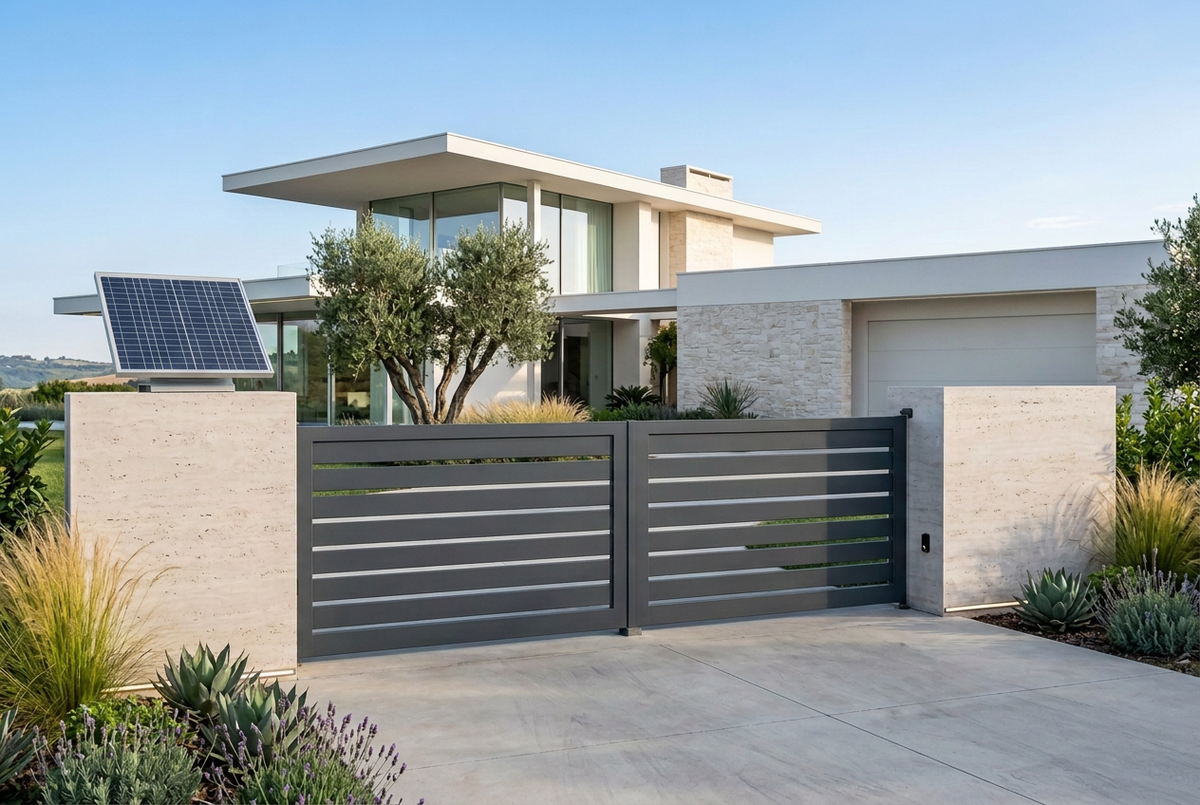
SOLAR 2-LEAF SWING GATE OPENERS
💡 Quick Buyer's Guide: Which technology is right for you?
- Standard 12V Systems (Recommended for most installations) Maximum energy efficiencyIdeal for standard-sized gates and regular residential use Excellent value for money.
- DUKAPP 24V Range (For large structures or heavy-duty gates) Superior power and smooth operation Features an innovative battery charge balancing system to extend battery life
- DUKAPP Smart Range (For premium demands)Ultimate control right at your fingertipsAllows you to monitor battery charge status and manage your gate directly from your smartphone
📐 Select your gate size below to explore compatible models:


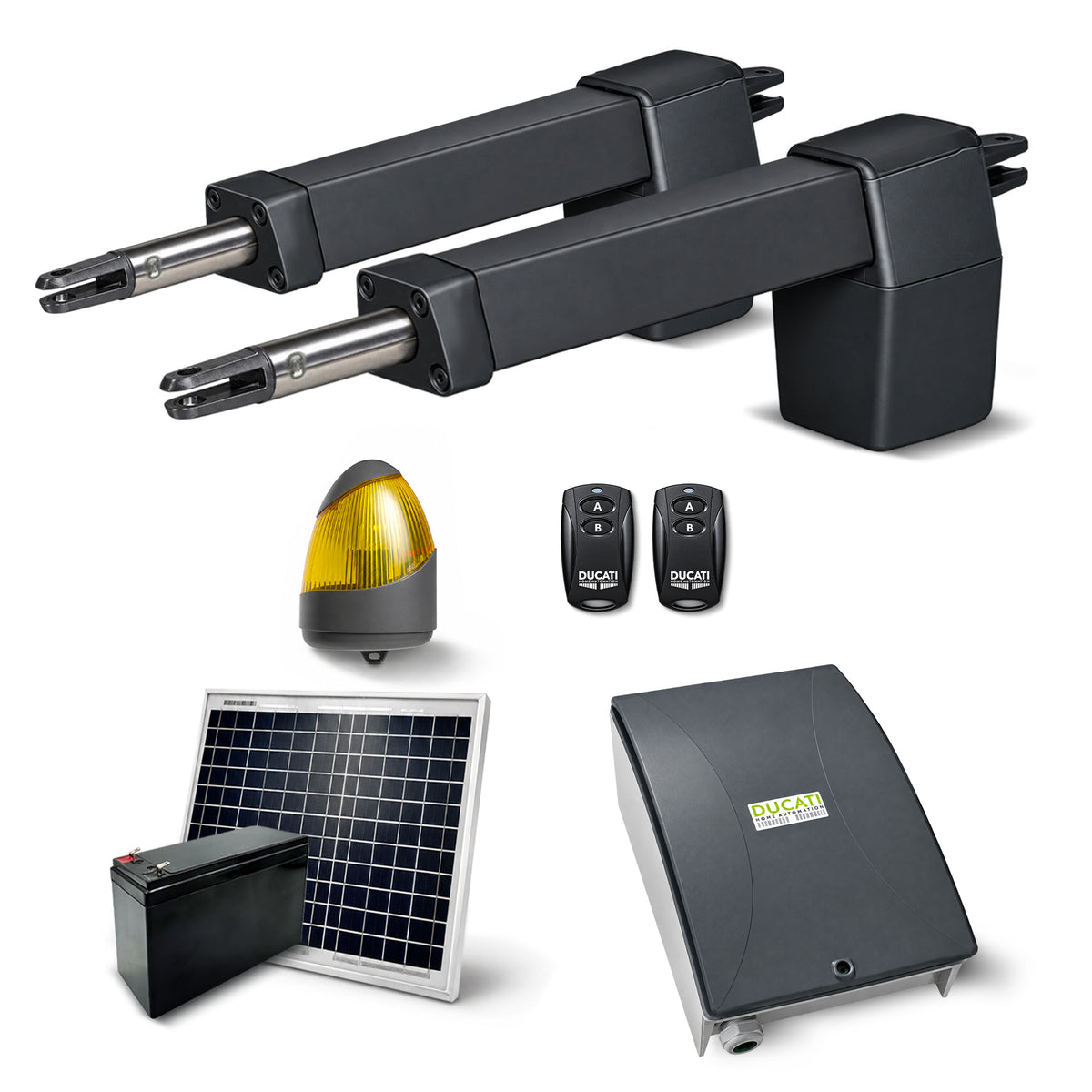


Technical Guide: Understanding the Solar Energy Balance
When choosing a solar-powered automation system, customers frequently ask: "How many daily openings does a solar kit guarantee?"
The accurate answer relies not on a static number, but on a dynamic Energy Balance between the Amperes consumed by the system and the Amperes recharged back into the battery. It is a simple equation: Energy In vs. Energy Out.
1. Energy Out (Consumption)
The energy drawn from your battery reservoir is determined by three factors:
• Daily and Nightly Cycles: The total number of complete opening and closing maneuvers performed across 24 hours.
• Standby Current Consumption: This is the single most critical factor. While a motor only moves for 10 to 30 seconds per cycle, the automation board sits in standby waiting for a command 24 hours a day. DUCATI control boards are engineered specifically to minimize this continuous drain, drawing between a microscopic 0.003A and 0.02A depending on the specific model.
• The Accessory Trap: Adding hardwired external accessories drastically alters the balance. Devices like external radio receivers, photocells, or GSM/Wi-Fi modules run continuously 24/7. A single pair of photocells can account for up to 60% of the board's entire standby consumption, while external receivers can more than double it.
2. Energy In (Recharging)
The amount of current successfully replenished back into the battery reservoir depends on:
• The size and wattage capacity of the solar panel (DUCATI electronic boards generally support 10W to 20W panels).
• The daily hours and quality of exposure to light (correct orientation facing SOUTH and optimal inclination angle).
• Real-world weather conditions and actual light intensity measurable in LUX.
• The absence of physical blockages casting shadows, or layers of dust, dirt, leaves, and snow covering the solar cells.
Real-World Performance & Climate Factors
Under average European lighting conditions, a standard DUCATI solar gate opener kit equipped with a 7A battery and a 10W panel easily handles up to 50 operating cycles per day, making it perfectly optimized for autonomous single-family or two-family residential properties all year round. However, seasonal climate realities must be considered:
• Extended Bad Weather & Fog: During prolonged overcast, stormy, or foggy periods, the solar panel cannot actively recharge the system. Because the battery acts as your primary energy reserve, it must supply the power. In areas prone to long stretches of poor weather, it is highly recommended to increase the battery capacity to act as a larger reserve tank.
• Solar Panel Upper Limits: While you can increase solar panel size to accelerate charging speeds, you must stay within the upper thresholds supported by your electronic card (typically a maximum charging limit of 2A, depending on the model).
• Extreme Temperatures: Solar hardware is sensitive to environment extremes. Solar panels and batteries degrade under extreme heat, and chemical lead-gel batteries lose their ability to accept or hold an electrical charge when temperatures drop below freezing (0°C / 32°F).
❓ FAQs: Everything You Need to Know about solar powered openers
Can I add extra accessories like photocells or external receivers to a solar kit?
Yes, but you must keep continuous current draw in mind. Accessories that stay powered 24/7 dramatically increase standby energy consumption. For example, a single pair of photocells can consume up to 60% of the control board’s entire standby energy, and external radio receivers, GSM, or Wi-Fi modules can more than double it. If you plan to install multiple hardwired accessories, you must factor this extra drain into your energy balance and we highly recommend increasing your battery capacity to compensate. Before adding any extra accessory, expecialli if not an original ducati one, first checj the device stand-by consumption tobe compliant with the limits of your solar powered system.
How many openings/cycles does a solar kit guarantee per day?
Under standard single- or two-family residential use with average European lighting conditions, a standard DUCATI kit equipped with a 7A battery and a 10W panel easily handles up to 50 operating cycles per day.
However, there is no single fixed number for every property because solar automation relies on a balance between energy consumed and energy recharged. Consumption is driven by your daily cycles, but more importantly, by standby power drain and continuous accessory loads.
Will my solar gate opener work at night or during bad weather?
Absolutely, yes. The solar panel doesn't power the motors directly during operation; instead, it constantly recharges a backup battery housed inside the control unit. Thanks to our exclusive low-consumption technology—which reduces standby power drain to an incredible 0.003 A/h—our systems preserve energy exceptionally well. This guarantees excellent operating autonomy even through consecutive days of rain, overcast skies, or at night.
How long do the batteries last before they need to be replaced?
In theory, a brand-new battery in perfect condition and subjected to correct charge-discharge cycles could last between 3 to 5 years.
In reality, however, this lifespan can be significantly reduced by actual on-site factors, including local climate extremes, daily usage frequency, initial storage conditions, and total discharge depth.
To protect our customers from high long-term maintenance costs, all our systems run on standard lead-gel (AGM) batteries.
These are highly affordable and easily available from any local or online retailer, meaning you will never be locked into buying expensive, proprietary custom batteries.
Additionally, our upcoming 24V DUKAPP range features a smart charge-balancing system: by independently managing the two 12V batteries required for 24V operation, it prevents uneven charging and helps protect them from premature wear, ensuring you get the absolute best performance out of your setup regardless of real-world variables.
What voltage should my solar panel and electronic board display during a health check?
When testing your components with a multimeter under optimal, direct sunlight, keep these guidelines in mind:
- The Solar Panel (12V Nominal): Disconnected from the electronic board, a standard 12V solar panel should read above 18V (and can reach up to 22V in direct sunlight). Any value below 15V indicates insufficient charging output.
- The Control Board Charging Output: With the solar panel connected but the batteries disconnected, the charging cables coming from a DUCATI board (such as models CTH44, CTH48, or PR70) should read an ideal charging value between 13.5V and 14.5V.
- Testing Batteries in 24V Systems: Even if your automation system runs on 24V, it uses two standard 12V batteries connected in a series. Batteries must always be disconnected and checked individually. Testing them together as a 24V block will hide a single failing or unbalanced cell, which could cause system malfunctions. [1]
Would you like me to output the entire, absolute master list of 14 FAQs into a single block with this correction applied, or should I translate this specific answer into Italian for your local records?Le risposte dell'AI potrebbero contenere errori. Scopri di più
- Il tuo caricamento·Solo tu puoi vedere questa schedaSOLAR-BATTERY-POWERED-SYSTEMS-techinal-support-form -ENG.pdfPage 3
Do I need to install massive, eyesore solar panels on my property?
Not at all; the visual impact is minimal. Because DUCATI automations have been engineered for over 30 years to minimize standby power waste, we don't require oversized, bulky hardware.
A very compact, lightweight, and non-invasive solar panel is more than enough to keep your battery fully charged.
Can I install a solar system if my gate doesn't get direct sunlight all day?
Yes, you can. Our photovoltaic panels are highly efficient and can harvest energy even from diffused ambient light on cloudy days. The key is simply to install the panel in a spot free from permanent, heavy shadows (such as dense tree canopies or north-facing overhangs) to ensure a steady trickle charge during daylight hours.
What happens to the solar gate opener during heavy fog or consecutive days of bad weather?
During thick fog or prolonged winter storms, the solar panel's charging efficiency drops significantly. Because the system relies on the battery as an energy reservoir, it will continue to operate normally using stored power. However, in a total absence of recharging, a standard 7A battery in perfect condition provides an operating autonomy of approximately 3 to 4 days before running out of sufficient voltage. If your region experiences frequent, consecutive weeks of heavy winter fog, we highly recommend upgrading to a larger battery capacity (such as a 12A battery) to act as a larger reserve tank.
Does extreme heat or freezing winter weather affect the solar system?
Yes. Both batteries and solar panels experience physical performance drops under extreme heat. Furthermore, lead-gel batteries lose their chemical capacity to receive a charge when temperatures drop below freezing (0°C / 32°F). Our low-consumption technology helps mitigate this by reducing the overall daily charging load required, but geographic areas with prolonged sub-zero temperatures require proper installation planning
What is the benefit of going solar if my home already has grid electricity?
Beyond completely eliminating gate-related costs on your electricity bill, the main benefit is total independence and peace of mind.
If your neighborhood experiences a power outage or blackout, your gate will continue to open and close normally.
Additionally, solar power saves you from expensive and messy backyard trenching to run 230V electrical cables from your house all the way down to the gate post.
Should I choose a 12V or a 24V automation system?
- For Swing Gates, we highly recommend our 12V systems: In a swing gate, the weight is completely supported by the hinges, meaning the movement of the leaves is not significantly affected by their overall mass. As long as the hinges are properly balanced and free of unusual friction, a 12V system is more than sufficient. Choosing 12V also makes solar energy management simpler, highly reliable, and much more cost-effective.
- For Sliding Gates and Overhead Garage Doors, a 24V system is preferred: Moving these heavy masses horizontally or vertically generates a strong force of inertia. A 24V system delivers more powerful motors, higher top speeds, and a far superior slowdown control as the gate approaches its final position. This smooth deceleration dampens the inertia perfectly before stopping, preventing the gate from slamming into the limit switches. For these specific applications, we highly recommend choosing an automation system from our DUKAPP Range to take full advantage of its specialized performance features.
- For Window Shutter Automations: All our shutter systems are offered exclusively in 12V versions, which are perfectly optimized for managing these specific types of motorized window fixtures smoothly and efficiently.
- For the MyPark Parking Post: The MyPark parking bollard is an autonomous 12V system powered solely by a battery, without a solar panel. We purposefully designed it without a solar panel because our low-consumption technology keeps standby energy drain so low that battery autonomy is exceptionally long. Furthermore, adding a solar panel would introduce unnecessary complications: a panel installed directly on a ground bollard becomes completely ineffective during the day when a vehicle is parked over it and blocking the sun.
Can I check the status of my solar charging?
With traditional systems, checking the power requires manual testing with tools. If you want seamless control, our upcoming DUKAPP line offers remote management straight from your smartphone. You will be able to monitor the exact battery charge percentage and see exactly how much energy your solar panel is generating in real time
How do I know if my solar battery is healthy or needs to be replaced?
The most accurate way to check a 12V battery's health is by measuring its Voltage (V) under absorption load—meaning while the motors are actively running.
A healthy, fully charged battery sits at a minimum of 12.8V DC when completely idle (no-load).
When the gate starts moving, the voltage will drop slightly, but it must never fall below 12.2V - 12.4V. If your battery voltage suddenly plunges under load (for example, dropping from 13.2V idle to 10V or less when the motors turn on), the battery is exhausted or damaged by sulfation and must be replaced.
Warning: The solar panel must be disconnected while measuring the battery voltage
Can I recharge my solar kit's battery with a standard plug-in charger if needed?
Yes. If your battery drops below 12.3V, it is considered fully discharged and should be recharged using a plug-in charger before being reconnected to the solar system.
However, you must only use battery chargers suitable for lead-acid/gel batteries that feature an automatic charge control system.
The charger must deliver an ideal charging voltage between 13.5V and 14.5V and automatically shut off power when the battery is full to prevent permanent plate damage.